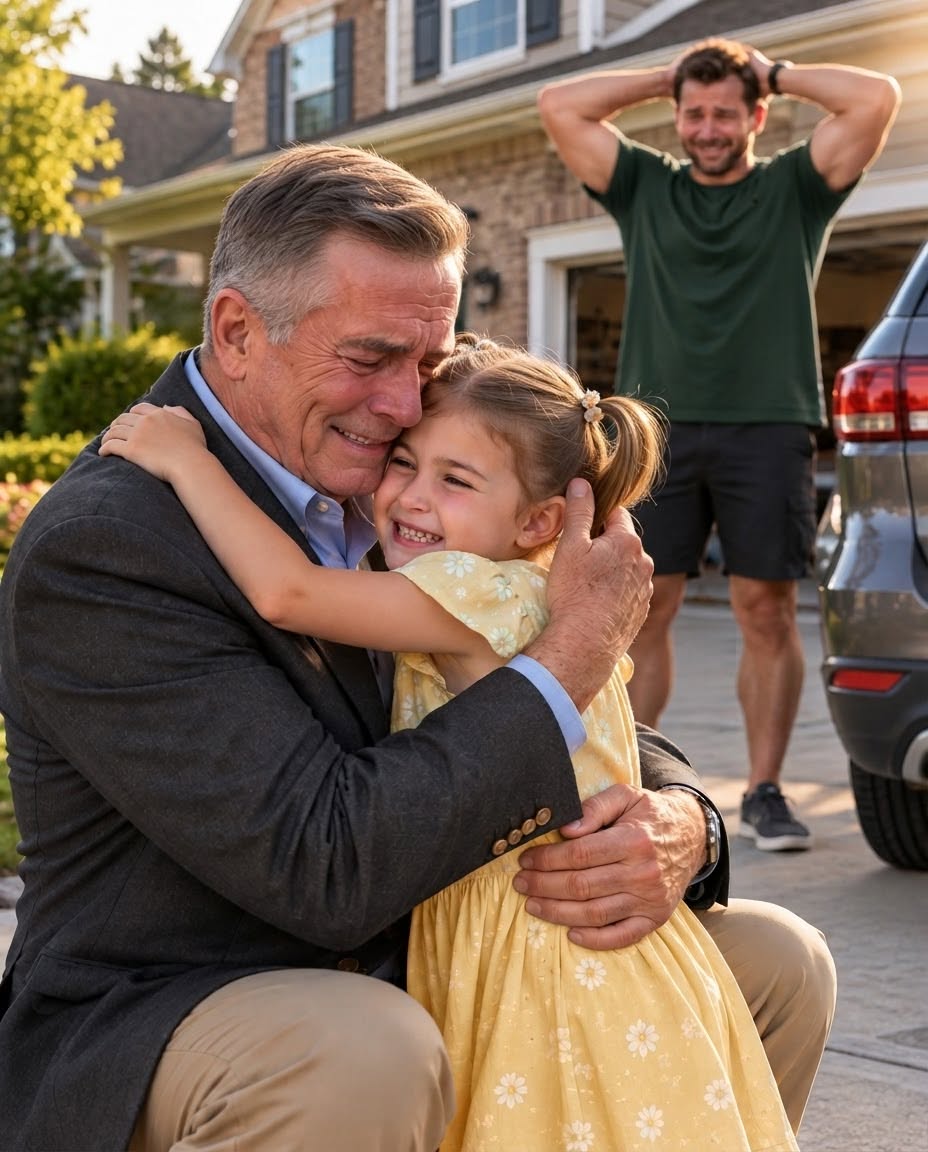
My seven-year-old granddaughter grabbed my hand and begged me to stop sending her father $40,000 every year. “Grandpa, please don’t give Daddy any more money. If you follow him one day, you’ll understand why.” For seven years, I’d faithfully sent my son-in-law that money to help raise Ava after my only daughter, Melissa, supposedly died in a terrible car accident. I’d never questioned him. I’d never asked for receipts. I trusted him because he was family. But three days after Ava’s strange warning, I followed Calvin to a neurological rehabilitation center. There, I watched him approach a thin woman standing near the entrance and hand her a cup of coffee. When she turned her head, I noticed a small scar above her eyebrow. My entire body went cold. I recognized that scar. I’d been there when she got it at nine years old. **The woman standing beside my son-in-law was Melissa—my daughter, whom I’d buried seven years earlier.** My hands began shaking. And suddenly, the $280,000 I’d given Calvin over the years was the least disturbing part of what I was about to uncover. It started on an ordinary Saturday afternoon. My granddaughter Ava and I were sitting beneath the enormous oak tree behind Grant Family Market, the grocery store my family had owned for generations. Every other weekend, I picked her up and brought her to the store for ice cream. It was our special tradition. That afternoon, she’d chosen strawberry. There was a little pink ice cream on her chin, and she’d just finished telling me about the perfect score she’d earned on her spelling test. I was considering buying her another scoop to celebrate when she suddenly grabbed my sleeve. “Grandpa?” “Yes, sweetheart?” Her expression had changed. “Please stop giving Daddy money.” I looked at her in surprise. “What do you mean?” “The money you send him every year.” I smiled gently. “Ava, that money helps your father take care of you.” She immediately shook her head. “No, Grandpa. You don’t understand.” I leaned closer. “Then tell me.” She glanced toward the parking lot. Her fingers tightened around my sleeve. “You need to follow him.” I frowned. “Follow who?” “Daddy.” I stared at her. “Why would I need to follow your father?” She lowered her voice. “Just do it one afternoon. Please.” Something about her seriousness troubled me. Ava was normally a cheerful, talkative child. She loved telling jokes, asking questions, and sharing funny stories about customers who visited my store. She wasn’t the kind of little girl who made mysterious requests. I reached for her hand. “Ava, is your father being unkind to you?” She quickly shook her head. “No.” “Is something happening at home?” She looked down. “I can’t tell you.” “Why not?” “Because Daddy might get upset.” I felt my stomach tighten. I wanted to ask more questions, but Ava suddenly reminded me that Calvin expected her home soon. She seemed anxious about arriving late. I wiped the ice cream from her chin, helped her gather her belongings, and drove her back. But her words stayed with me. *Grandpa, stop sending Daddy money.* *Follow him one day.* That evening, I sat alone in my kitchen, thinking about the past seven years. Seven years earlier, my daughter Melissa had supposedly died in a devastating accident on Highway 24. She’d been driving during a storm when her vehicle crashed and caught fire. The damage was so severe that we were told there could be no viewing. Calvin, her husband, had handled much of the funeral planning. My wife, Dorothy, and I were overwhelmed with grief. We accepted the explanations we were given because we had no reason to question them. Eventually, we brought home a sealed urn containing what we believed were Melissa’s ashes. I placed it beside her photograph. And every morning afterward, I looked at that picture and wished I could hear my daughter’s voice again. Melissa was our only child. She’d practically grown up inside Grant Family Market. As a little girl, she helped arrange fruit displays, handed shopping bags to customers, and sneaked cinnamon rolls from the bakery counter whenever she thought I wasn’t looking. I could still picture her sitting on a stool behind the cash register, swinging her legs while finishing her homework. She had a beautiful laugh. And whenever something bothered her, she called me before anyone else. Losing her left a silence in our home that nothing could fill. Then, six months after her funeral, tragedy struck again. My wife Dorothy suffered a cardiac arrest and passed away. The doctors explained the medical circumstances, but I often wondered whether the grief she’d experienced had made those final months even harder. In less than a year, I’d lost the two people I loved most. For a long time, I barely knew how to continue. Then I would see Ava. She had been only a baby when Melissa supposedly died. Too young to understand why her mother wasn’t coming home. And every time I looked into her eyes, I remembered something Melissa had once said to me. “Dad, promise me you’ll always look after Ava, no matter what happens.” I’d promised. And I intended to keep that promise for the rest of my life. Calvin was raising her alone. I knew how expensive children could be. Clothes. School supplies. Groceries. Medical appointments. Transportation. Unexpected bills. I also knew I wasn’t prepared to raise a little girl by myself while running the family business. But I could make sure she never lacked financial support. So I began sending Calvin $40,000 every January. Some years, the store’s expenses were difficult to manage. Once, an old commercial freezer broke down and cost thousands to replace. Another year, the building needed significant repairs. But I always made sure Calvin received the money. He thanked me. I asked how Ava was doing. And we continued with our lives. I never requested an explanation of how the money was spent. I trusted him. He was my daughter’s husband. My granddaughter’s father. The man I believed was carrying the burden of raising Ava without Melissa. Questioning his finances felt almost disrespectful. And whenever I spent time with Ava, she seemed happy. She loved school. She proudly showed me her drawings. She enjoyed helping at the grocery store. She even knew the habits of our regular customers. Once, she informed me that Mrs. Patterson bought six cinnamon rolls every Friday because she loved eating them herself, not because she had grandchildren visiting. Mrs. Patterson overheard her and laughed. Ava was right. Those small moments reassured me that my granddaughter was growing up in a loving home. But after her warning beneath the oak tree, I began noticing things I’d previously overlooked. The previous winter, Ava had worn a coat with sleeves that were too short. One pocket had been repaired with fabric that didn’t match. Calvin told me she loved that coat and refused to wear another. I’d believed him. But now I wondered why someone receiving $40,000 each year for his daughter’s needs always seemed concerned about expenses. Perhaps there was an innocent explanation. Children were expensive. And I didn’t know everything about Calvin’s financial circumstances. Still, something bothered me. Ava hadn’t asked me to check his spending. She’d specifically told me to follow him. That night, I opened my banking records. Seven annual transfers appeared. Each one for $40,000. **$280,000 in total.** I stared at the number. For years, I’d believed every dollar was helping the little girl Melissa had asked me to protect. Now I wasn’t sure what to believe. I wished Dorothy were sitting beside me. She’d always been better at recognizing when someone was trying to communicate something important without saying it directly. If she were alive, she probably would have reminded me to listen carefully to Ava instead of assuming I already understood. The following afternoon, I called Calvin. “Hey, Calvin. How’s Ava doing?” “She’s great, Daniel. She spent half the evening talking about her spelling test.” I smiled faintly. “She was proud of herself.” “She should be.” I hesitated. “Has anything been bothering her lately?” Calvin sounded confused. “Not that I’ve noticed. Why?” “Just wondering.” I heard dishes clattering in the background. Everything sounded perfectly ordinary. For a moment, I considered confronting him about the money. But then I remembered Ava’s worried expression. She’d trusted me enough to give me a warning. I wanted to understand what she meant before making accusations. So I ended the conversation without mentioning anything. On Tuesday afternoon, I made an unusual decision. I closed Grant Family Market early. My longtime manager, Maria, watched as I turned the sign on the entrance door. “Daniel, is everything okay?” I nodded. “I hope I’ll know soon.” She looked concerned but didn’t question me further. I drove toward Calvin’s office and parked across the street. At exactly 4:37 p.m., his black SUV pulled out of the parking lot. I waited until another vehicle passed, then followed him at a distance. I felt foolish. I’d spent my entire life believing that honesty and trust were the foundation of a family. Now I was secretly following my own son-in-law through traffic. But every time I considered turning around, I remembered Ava holding my sleeve. *Please, Grandpa. You need to see where he goes.* So I continued. For approximately forty minutes, Calvin drove through the city. Eventually, he turned toward an older medical district. Several modern healthcare buildings stood among landscaped gardens and carefully maintained parking lots. He pulled into the driveway of a facility with wide glass doors. I parked far enough away that I could observe without drawing attention. Then I waited. A woman was standing near the entrance. She wore a blue cardigan and held a small folder. Calvin approached her carrying a paper coffee cup. She accepted it with both hands. He opened another folder and began showing her something. From where I sat, it looked like a routine conversation about paperwork. I wondered whether Calvin was visiting a relative. Perhaps someone was ill. Perhaps the $40,000 was being used to support medical treatment. That possibility actually brought me a small sense of relief. If Calvin had been helping someone through a difficult medical situation, perhaps he was simply embarrassed to explain. Then the woman raised her head. And everything changed. I leaned forward. Her hair was different from what I remembered. She was much thinner. Her posture seemed unfamiliar. But there was something about her face. Something I recognized. Then she turned slightly toward the parking lot. And I saw it. A tiny scar just above her eyebrow. My breath caught. I knew that scar. Melissa had gotten it when she was nine years old. She’d fallen off her bicycle while racing down the driveway. I remembered rushing outside after hearing her cry. Blood had trickled from a small cut near her eyebrow, and I’d been terrified. But Melissa wasn’t worried about the injury. She was furious about her bicycle. “Dad! Look what happened to my bike!” I’d laughed through my worry. “Sweetheart, the bicycle can be repaired. I’m just glad you’re okay.” The wound eventually healed. But it left a faint mark above her eyebrow. A mark I knew as well as my own face. And now I was seeing that same scar on a woman standing beside Calvin. My hands began trembling. I leaned closer to the windshield. The woman turned again. I saw her eyes. Her nose. The familiar shape of her face. My chest tightened so painfully that I struggled to breathe. “Melissa?” I whispered the name without realizing I’d spoken. It couldn’t be. My daughter had died seven years earlier. I’d attended her funeral. I’d carried her urn home. I’d spent countless nights staring at her photograph, wishing I could speak to her one more time. Yet the woman standing outside that building looked exactly like her. Older. Thinner. Different in ways I couldn’t explain. But unmistakably familiar. I reached for the car door. Every instinct told me to run across the parking lot. To shout her name. To demand that Calvin explain what I was seeing. But then Ava’s words returned. *Follow Daddy. You’ll understand.* I forced myself to remain seated. Calvin and the woman finished their conversation. Then they entered the building together. Only after they disappeared did I look carefully at the sign above the entrance. **HAVENWOOD NEUROLOGICAL RECOVERY CENTER.** I stared at the words. A neurological rehabilitation facility? Why would Calvin be visiting a place like that? Had Melissa somehow survived the accident? If so, why had everyone told us she was dead? And why had Calvin allowed my wife and me to mourn her? My mind raced. I looked toward the entrance again. For seven years, I’d believed my daughter was gone. Every birthday, I’d placed flowers beside her photograph. Every anniversary of the accident, I’d spoken to her as though she might somehow hear me. I’d watched Dorothy mourn our only child. I’d buried my wife only six months later. And now, less than an hour from my own grocery store, I’d seen a woman who appeared to be Melissa. I waited. Eventually, Calvin came out of the building alone. He looked tired. Before getting into his SUV, he stopped beside the driver’s door and rubbed his eyes. For a moment, he stood motionless. Then he climbed into the vehicle and drove away. I didn’t follow him. My attention was fixed on Havenwood. I’d expected to discover where Calvin was spending the money. Maybe an undisclosed debt. Perhaps a hidden relationship. Possibly a serious expense he was ashamed to explain. But nothing could have prepared me for what I’d just witnessed. The woman I’d seen outside that building looked like the daughter I’d buried seven years ago. And I couldn’t leave without knowing whether my eyes had deceived me. I finally opened my car door. My legs felt unsteady as I crossed the parking lot. Inside the building, a receptionist greeted me. “Good afternoon, sir. How may I help you?” I struggled to find my voice. “I’m looking for someone.” “Of course. Who are you here to see?” I swallowed. “Melissa Brooks.” The receptionist glanced toward her computer. “May I ask your relationship to her?” I looked directly at her. “I’m her father.” She explained that patient information was confidential and could not be confirmed or discussed without proper authorization. Under normal circumstances, I would have understood immediately. But my thoughts were moving too quickly. “Please,” I said. “I saw her outside. I know she’s here.” The receptionist looked concerned. “Sir, I understand this is important to you, but we have procedures—” “My daughter died seven years ago.” The words came out before I could stop them. The woman fell silent. I gripped the edge of the reception counter. “At least, that’s what I’ve believed for seven years.” She stared at me, clearly unsure how to respond. I took a shaky breath. “I attended her funeral. I brought home her ashes. And now I’ve just seen a woman outside who looks exactly like her.” The receptionist’s expression softened. “Sir, perhaps I can find someone who can speak with you.” I nodded. I wanted to thank her. But before I could say anything, I heard footsteps behind me. Then a soft voice came from the hallway. “Dad?” I froze. That voice. I knew that voice. For seven years, I’d heard it only in old recordings and dreams. Sometimes I’d wake up convinced Melissa had called me from another room. Other times, I’d watch family videos just to hear her laugh again. Now that voice was coming from directly behind me. Slowly, I turned. A woman stood several feet away. She wore a soft blue cardigan. A staff member with a Havenwood identification badge stood beside her. Her face was thinner than I remembered. Her shoulders were slightly stooped. And there was hesitation in her expression. But I recognized her. The same eyes. The same gentle features. The same small scar above her eyebrow. My daughter. “Melissa?” I whispered. She took a hesitant step forward. Her eyes filled with tears. “Dad… is it really you?” I couldn’t move. For a moment, the entire world seemed to disappear. I forgot about the receptionist. The building. The parking lot. The money. All I could see was the woman I’d spent seven years mourning. Alive. Standing in front of me. Waiting for an answer. My throat tightened. I tried to speak, but no words came. I thought about all the birthdays we’d missed. The Christmas mornings when I’d placed a candle beside her photograph. The countless times I’d wished I could tell her about Ava. And the years Dorothy had never been given the chance to share with her daughter. I felt tears sliding down my cheeks. Melissa took another small step toward me. “Dad?” I finally managed to whisper her name again. “Melissa.” She began crying. And suddenly, the questions came rushing back. If my daughter was alive, what had happened after the accident? Why had we been told there could be no viewing? Whose ashes had we brought home? How long had she been at Havenwood? And most painfully of all… **How long had Calvin known the truth?** I’d given that man $40,000 every year because I believed he was raising Ava alone. I’d trusted him with my granddaughter. I’d trusted him with my daughter’s memory. And now I was standing in a medical facility, looking at the daughter he’d apparently been visiting without telling me. I still didn’t know what the money had been used for. I didn’t know why Ava had been afraid to explain what she’d discovered. And I didn’t understand how such an extraordinary secret could have been kept from me for seven years. But one thing had become undeniable. Everything I believed about Melissa’s death needed to be questioned. She stood in the hallway, looking at me with the same tearful disbelief I felt. For a moment, neither of us moved. Then I slowly opened my arms. And after seven years of believing I’d never hold my only daughter again, I took my first step toward her. But the truth about the accident, Calvin’s secret visits, and the $280,000 I’d sent him was still waiting to be uncovered. FULL STORY IN THE FIRST COMMENT BELOW 👇 Voir moins

please, Grandpa. Follow Daddy one day.” GetParenting Tips

Before I could ask another question, she reminded me that Calvin expected her home soon.

I wiped the ice cream from her face, hugged her, and promised we’d talk again.

But as I drove home, her words wouldn’t leave my mind.

I started thinking about things I’d previously dismissed.

The winter coat she’d worn the year before had become too short in the sleeves.

One pocket had been repaired with mismatched fabric.

Calvin had told me she loved that coat, and perhaps she did.

But if I was sending him $40,000 every year, why did he frequently complain that money was tight? Financialadvice service

I knew children were expensive.

I knew the cost of living had risen.

Still, Ava’s warning made me wonder whether something was happening that I hadn’t been told about.

That night, I opened my banking records.

Seven